
Article: Extendable Dining Tables for Small Spaces: How to Choose One That Fits
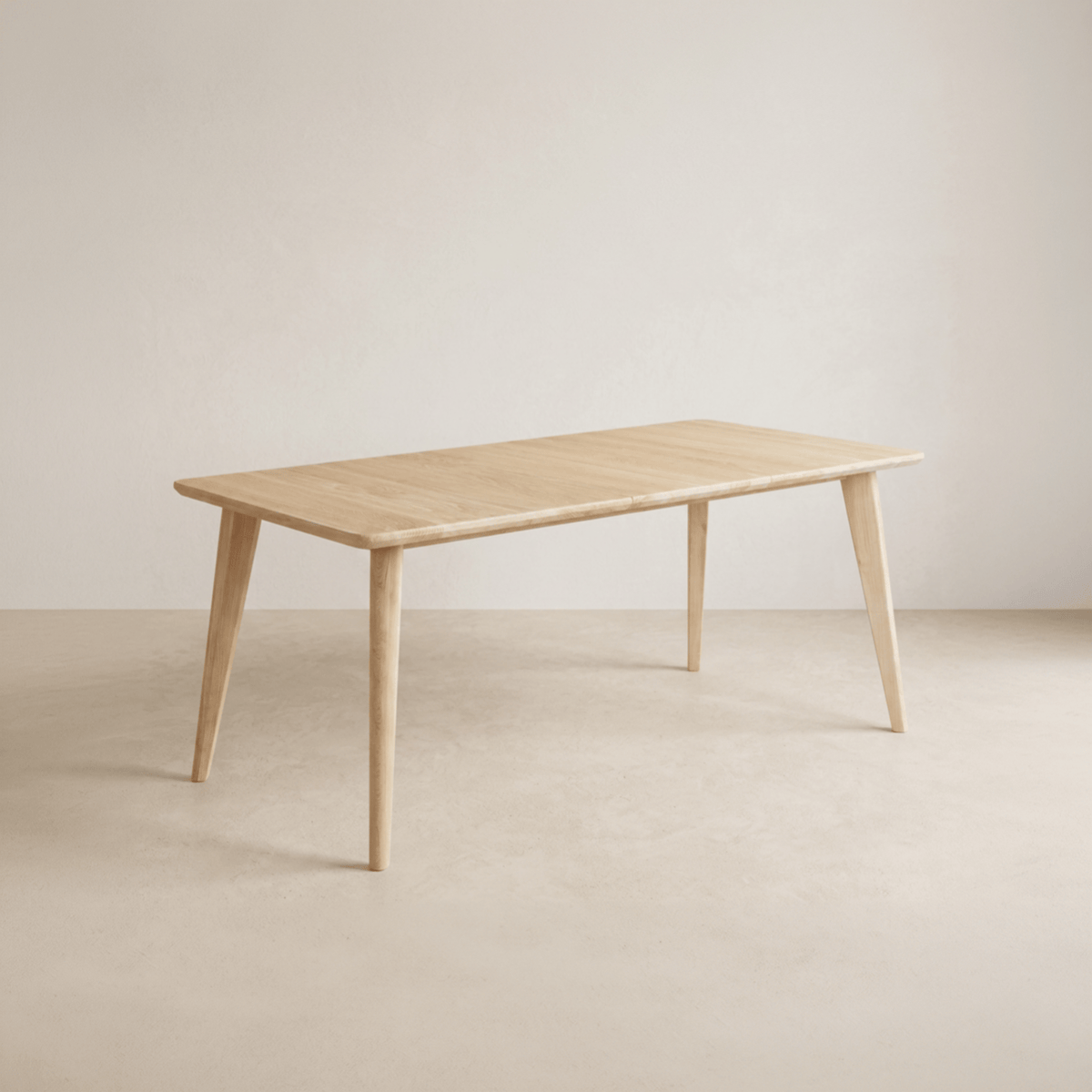
Extendable Dining Tables for Small Spaces: How to Choose One That Fits
Small every day. Ready for extra guests.
A dining table has to work on an ordinary Tuesday as well as when friends arrive for dinner. In a smaller home, that means leaving room for breakfast, work and the walk through to the kitchen, while still making space for the people you love.
An extendable dining table can offer that flexibility. The right choice fits your room comfortably when closed and leaves usable space for chairs and movement when open. This guide explains how to check both layouts, compare round and narrow rectangular designs, and choose seating that works with the table legs.
What makes an extendable dining table suitable for a small space?
Look for a compact closed footprint, an extended size your room can accommodate, and a leg layout that suits your chairs. Leaf storage matters too: a table saves less space if its extension panels have nowhere convenient to live.
Start with your everyday needs. How many people normally sit down together? How often do you host extra guests? Choose a closed size that serves daily life, then check the extended configuration against the number of people you actually expect to welcome.
How to measure your dining area before choosing a table
- Measure the usable space. Work from the fronts of cupboards, radiators and other furniture, rather than simply measuring wall to wall.
- Mark the closed tabletop on the floor. Use masking tape and position your chairs around it.
- Mark the fully extended outline. Check which direction the table grows and whether it needs repositioning.
- Try the room in use. Sit down, pull chairs back, open nearby doors and walk your usual route through the space.
As a planning starting point, allow around 90–100 cm between the tabletop edge and the nearest wall or furniture. Busy routes behind occupied chairs may need more room. This is a guide, rather than an accessibility standard: test your actual chairs and allow for the needs of everyone using the room.
Round or narrow rectangular: which shape fits your home?
A round table for a compact, roughly square dining area
A round tabletop can work well where the available space is similar in both directions. Its curved outline removes projecting corners, but it still needs enough room for chairs on every occupied side. When a round table extends into an oval, check the extra length as carefully as the original diameter.
A narrow rectangular table for a longer dining area
A narrow rectangular design can be a useful choice beside a kitchen or in a longer room. Its slimmer width may preserve more space across the room, while extension leaves add length for guests. Check that the narrower top still gives you enough space for place settings and serving dishes.
For a broader comparison, read our round vs rectangular dining table guide.
Compare three compact extension configurations
These examples come from our KANTAR product options. Dimensions describe the tabletop; they do not include chairs or circulation space. Check the selected configuration on the product page before ordering.
| Configuration | Closed | Fully extended | What to check |
|---|---|---|---|
| Round to oval, shorter extension | 100 cm diameter | 160 × 100 cm | Extra length at both ends and chair positions |
| Round to oval, longer extension | 100 cm diameter | 200 × 100 cm | The larger hosting footprint despite the same closed size |
| Narrow rectangular | 120 × 80 cm | 180 × 80 cm | End seating, leg clearance and serving space across the width |
Seating capacity depends on chair width, leg positions and how much elbow room you prefer. A maximum guest count is not a promise that every chair combination will fit comfortably. Our round dining table seating guide offers more context; use the product dimensions and your chosen chairs for the final check.
A worked example: will it fit in a 300 × 360 cm dining area?
Imagine a clear rectangular dining area measuring 300 cm across and 360 cm along its length, with no cupboards, radiators or door swings inside that space. Place the table centrally, with its extension running along the 360 cm direction.
- A 100 cm round table: leaves 100 cm to each side and 130 cm at each end when closed.
- The same table extended to 160 × 100 cm: leaves 100 cm on all four sides.
- The longer 200 × 100 cm configuration: leaves 100 cm to each side but only 80 cm at each end.
- A 120 × 80 cm rectangular table extended to 180 × 80 cm: leaves 110 cm to each side and 90 cm at each end.
These are distances from the tabletop edge to the boundary, before chairs are occupied. They show why the same compact closed table can produce very different hosting layouts. The 200 cm option would fall below our 90–100 cm planning starting point at the ends in this example. Try the layout with real chairs before deciding.
Will your chairs or bench fit between the table legs?
Tabletop size is only part of the picture. Check the clear distance between the legs at chair-seat height, the space beneath the top for armrests, and whether legs interfere with the places where guests will sit.
If you want a bench to tuck underneath, compare its full length and height with the actual opening between the table legs. A bench shorter than the tabletop will not necessarily fit between them. Also consider how people will get in and out, especially if the bench sits near a wall.
For help putting the whole arrangement together, see our guide to choosing an extending dining table and chairs.
Where will you store the extension leaves?
Ask whether the selected table stores its leaves internally or requires separate storage. For removable panels, measure your intended cupboard or storage area before ordering. Follow the care instructions for the chosen table and protect the leaves from knocks, moisture and direct heat.
You can also view our extending mechanism guide to understand how our tables open.
Planning for Christmas guests in a smaller home
Set up the extended layout before the occasion. Count the chairs you can comfortably place, keep the kitchen route clear and consider serving food from a sideboard if the tabletop is narrow. A simple centrepiece can leave more room for dishes and conversation.
If you are ordering for a particular celebration, contact us to confirm timing for your chosen configuration and destination. Check our shipping information when planning your order.
Frequently asked questions
Is a round extendable table always best for a small room?
No. A round table can suit a square area, while a narrow rectangular table may fit a long room more efficiently. Compare the closed and extended footprints with your chairs in position.
Can two tables with the same closed size need different amounts of space?
Yes. The 100 cm KANTAR round configurations above extend to either 160 cm or 200 cm long. Check the full extended dimensions of the option you select.
Do benches automatically save space?
A bench can reduce clutter when it fits beneath the table, but its dimensions, the table legs and access for the people using it all matter.
Find a table that fits your everyday life
At 7MAGOK, we handcraft furniture to order in our Devon workshop. Explore the KANTAR round extendable table, compare the narrow rectangular KANTAR, or browse the OAKWELL round extendable table for another design option.
Need help choosing? Send us your room measurements, everyday seating needs and the number of guests you would like to host. Include nearby doors, furniture and your chair dimensions, and we can help you compare suitable sizes and discuss custom options.


Leave a comment
This site is protected by hCaptcha and the hCaptcha Privacy Policy and Terms of Service apply.